
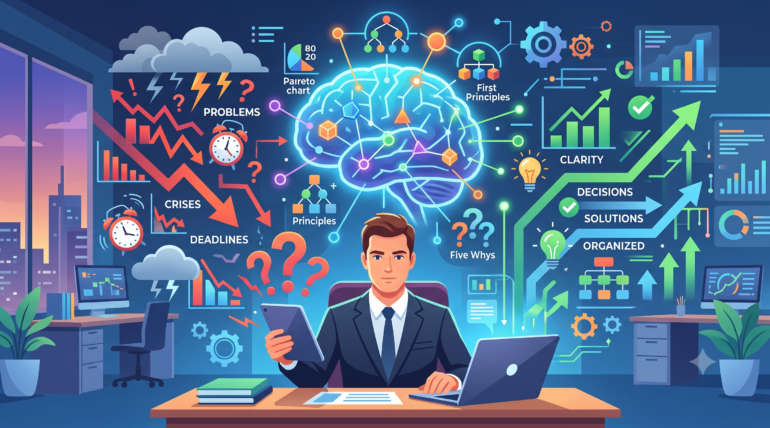
On an average Tuesday, an executive’s schedule is a predictable rhythm. Meetings flow smoothly. Progress is steady.
But what happens when a market shift hits? What if a high-stakes initiative crumbles? The rhythm shatters into high-stakes pressure.
In these moments, gut instinct often fails. Physiological stress leads to tunnel vision and reactive mistakes. Top-tier executives avoid this trap. How? They use professional “frameworks.”
These mental models provide clarity when the world feels chaotic. Adopt these seven frameworks to lead with precision.
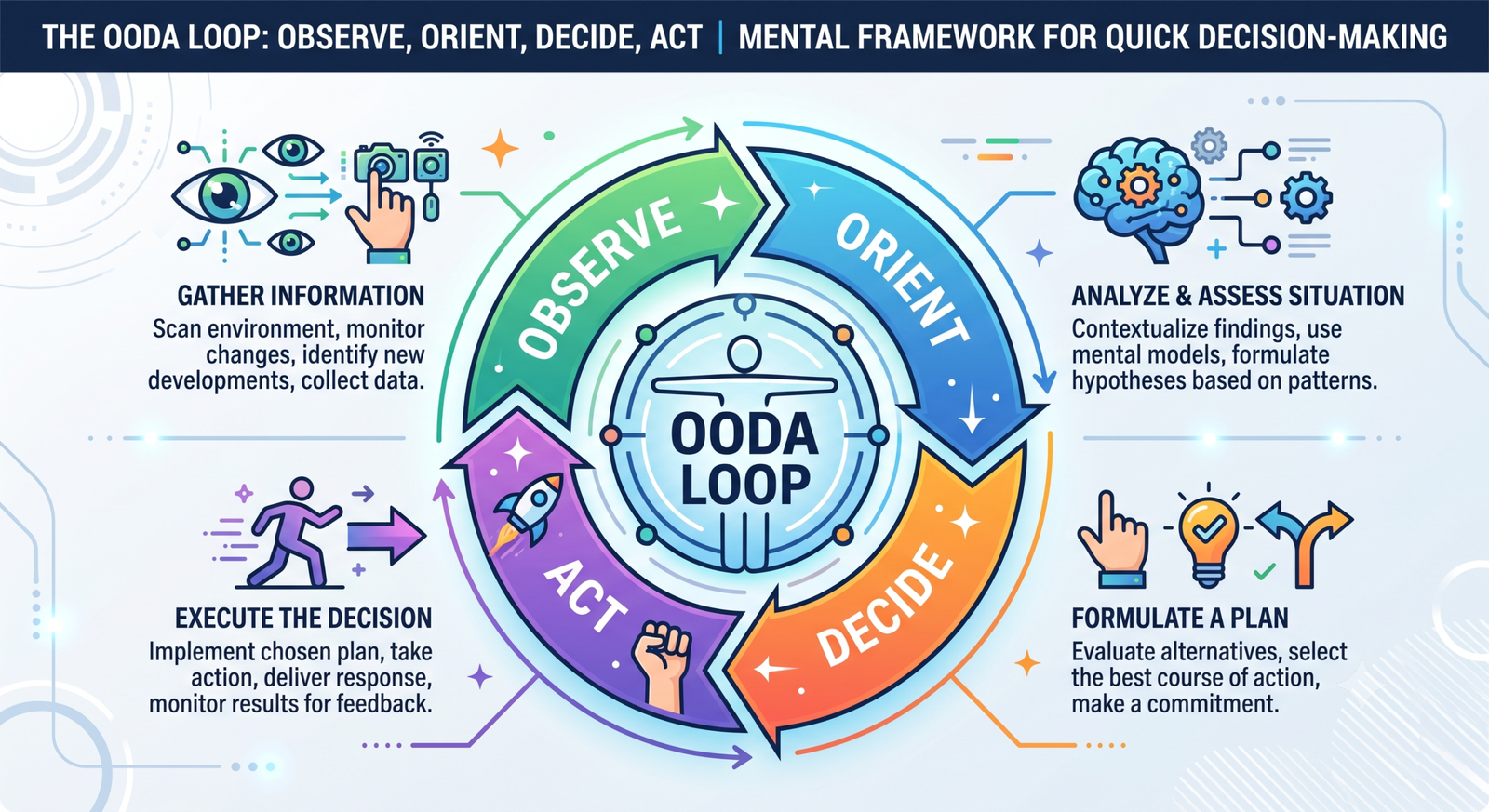
1. The Need for Speed: The OODA Loop
Developed by military strategist John Boyd, the OODA Loop is built for speed. In a crisis, don’t wait for “perfect” information.
Your goal is to decide faster than your environment changes. Cycle through these steps faster than your competition. You will reset their reality before they can react.
The Sequence:
- Observe: Gather real-time data.
- Orient: Analyze context.
- Decide: Choose the best response now.
- Act: Execute and test.
Best for: Competitive crises and market shifts.
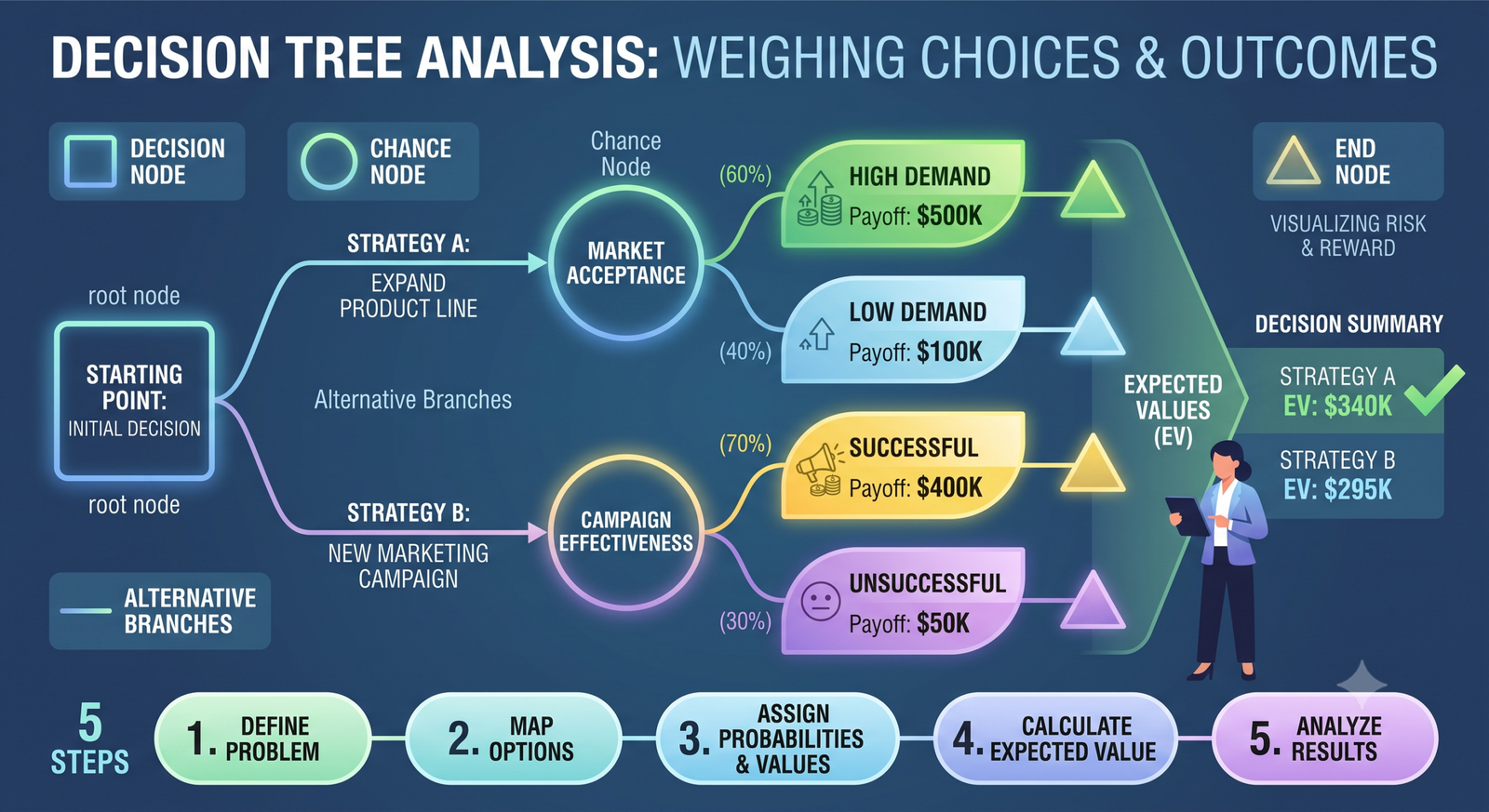
2. Visualizing Uncertainty: Decision Tree Analysis
High stakes meet high uncertainty. The human brain struggles to weigh it all. J. Ross Quinlan’s Decision Tree solves this.
Map your choices visually. Calculate potential ROI. See the true cost of inaction.
Externalize the problem. Find out if a “low probability” risk might actually destroy the organization.
- Option: Your specific choice.
- Outcome: The potential result.
- Chance: The statistical probability.
Best for: High-stakes decisions with massive uncertainty.
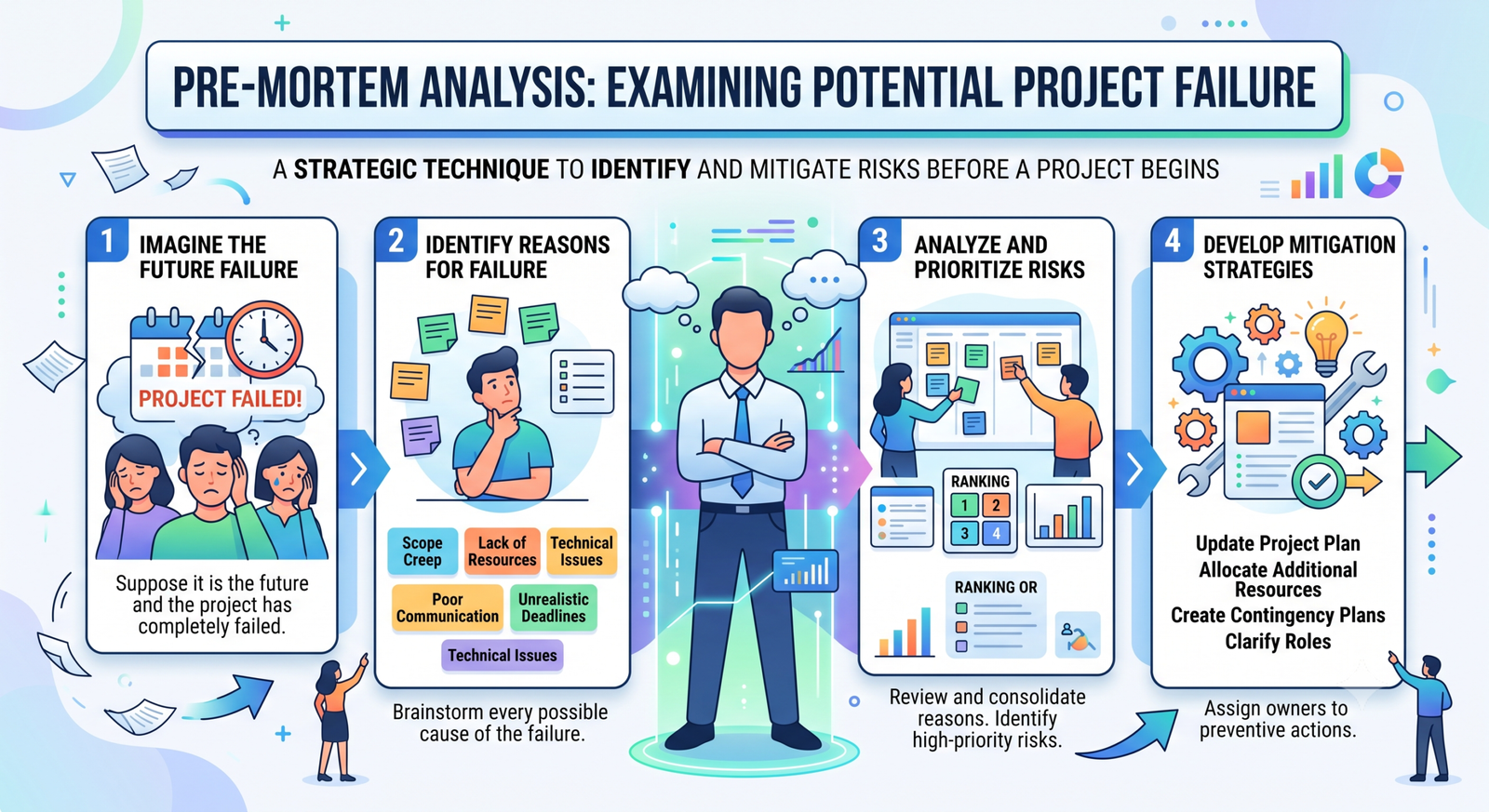
3. Productive Pessimism: Pre-Mortem Analysis
Most teams do a “post-mortem” after they fail. Gary Klein flips this. Do a “Pre-Mortem” before you launch.
Use “productive pessimism.” Imagine the project has already failed. This destroys optimism bias and groupthink.
Bring in “project killers” to speak freely about every possible point of failure.
The Directive: “Assume failure, list ‘why’, then prevent problems before they occur.”
Best for: New initiatives and strategic launches.
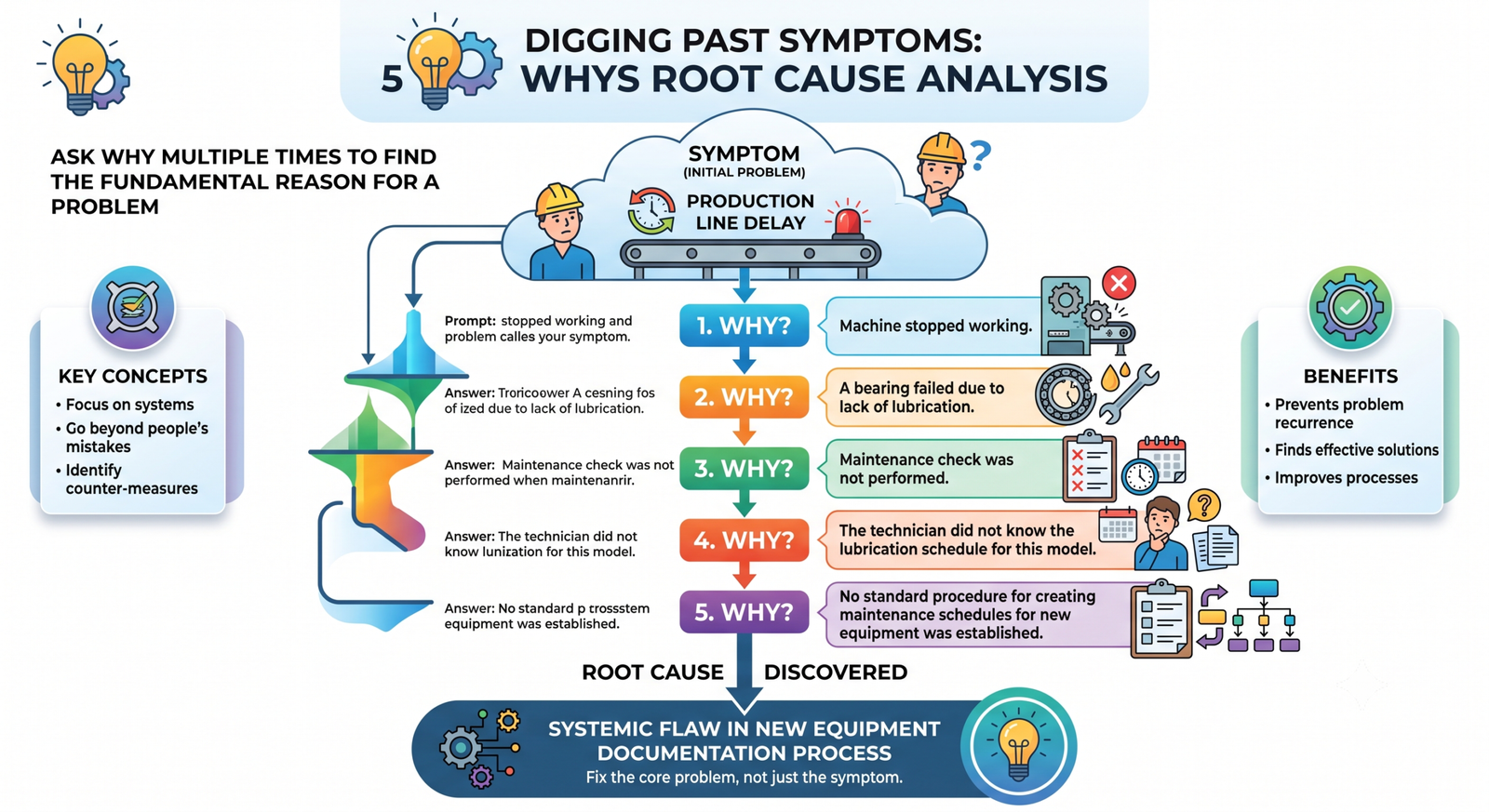
4. Getting Past Symptoms: The 5 Whys
In a crisis, executives waste capital fixing the first thing they see. Sakichi Toyoda’s Root Cause Analysis stops this.
Don’t treat the symptom while the disease kills your operations. Drill down. Ask “Why?” five times to reach the foundational truth.
Iterate past surface-level excuses until you hit the real root cause.
Best for: Recurring failures.
5. Deconstructing Reality: First Principles Thinking
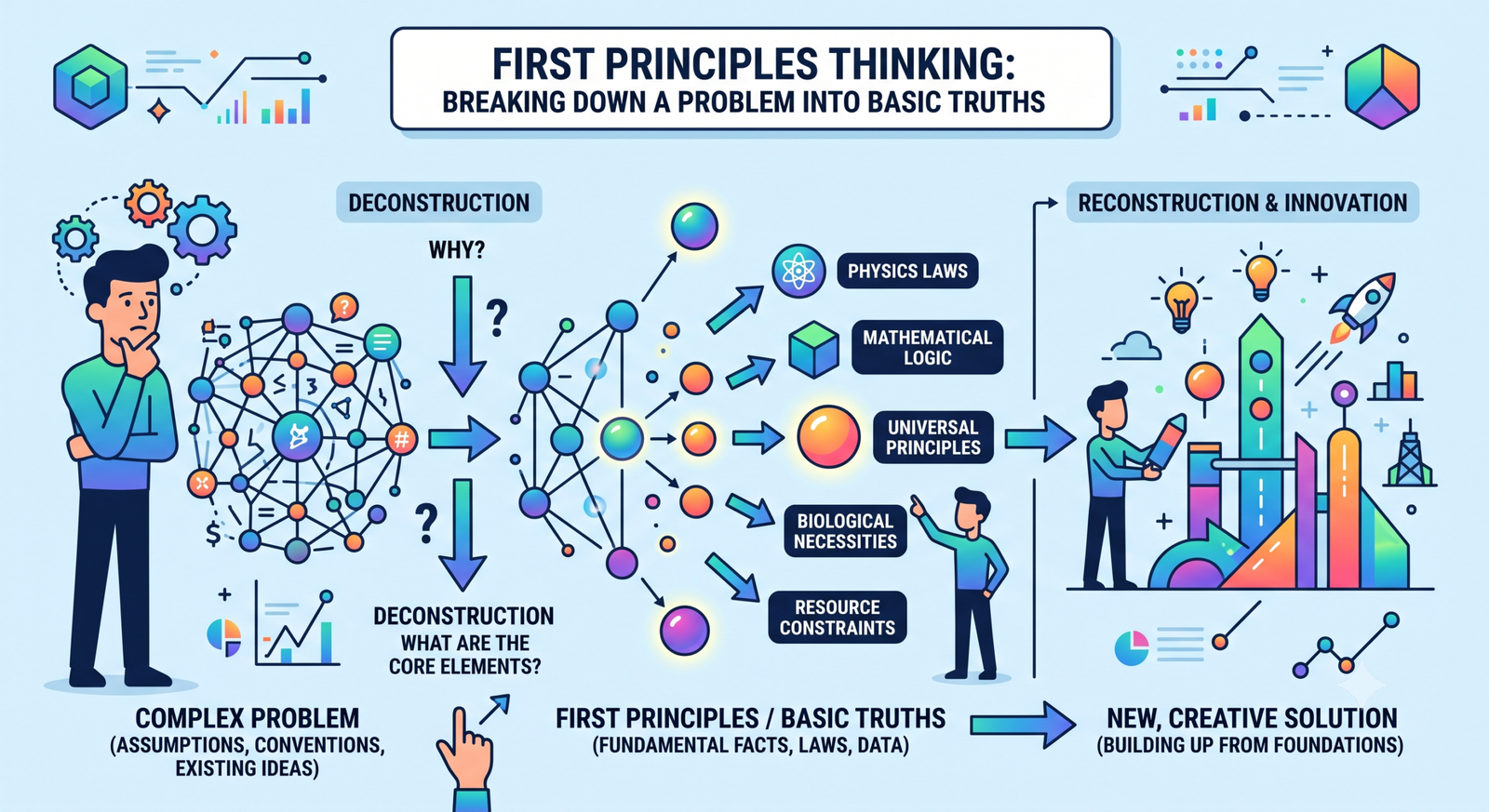
Attributed to Aristotle. Popularized by Elon Musk. First Principles is for when conventional wisdom fails.
Stop reasoning by analogy. Stop doing things “because that’s how it’s done.”
Deconstruct the problem into foundational truths. Question every assumption. Rebuild a fresh solution from the ground up.
Best for: Solving problems when conventional approaches fail.
6. The Anti-Groupthink Tool: Six Thinking Hats
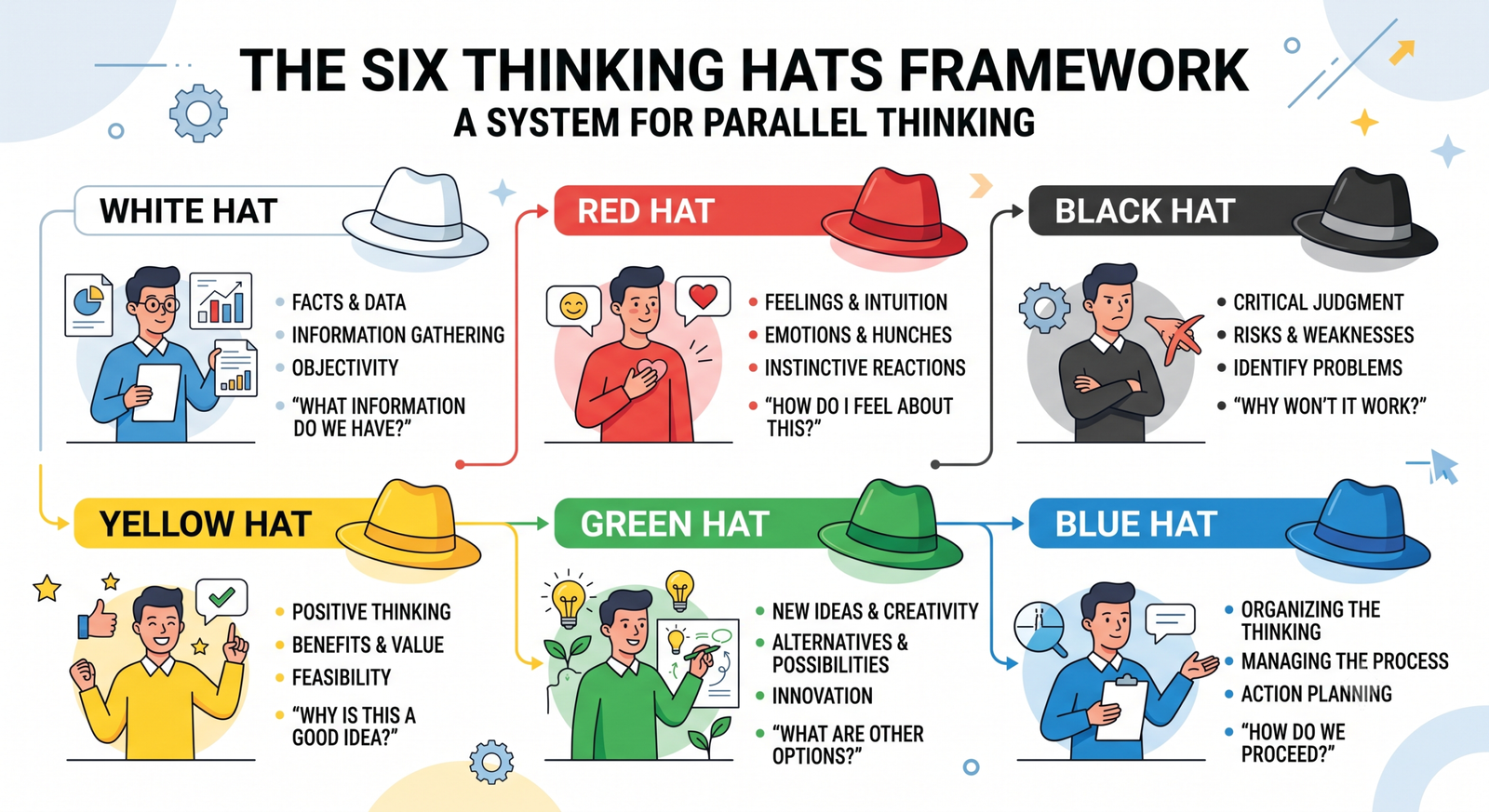
Ego is the enemy of sound decision-making. Edward de Bono’s framework uses “parallel thinking.”
Explore a problem from six perspectives simultaneously. Prevent ego-driven arguments. Balance risk and opportunity.
- White Hat: Facts and data.
- Red Hat: Feelings and intuition.
- Black Hat: Risks and downsides.
- Yellow Hat: Benefits and value.
- Green Hat: Creativity and new ideas.
- Blue Hat: Process and organization.
Best for: Team alignment and balanced collaboration.
7. The Data-Driven Standard: DMAIC Framework
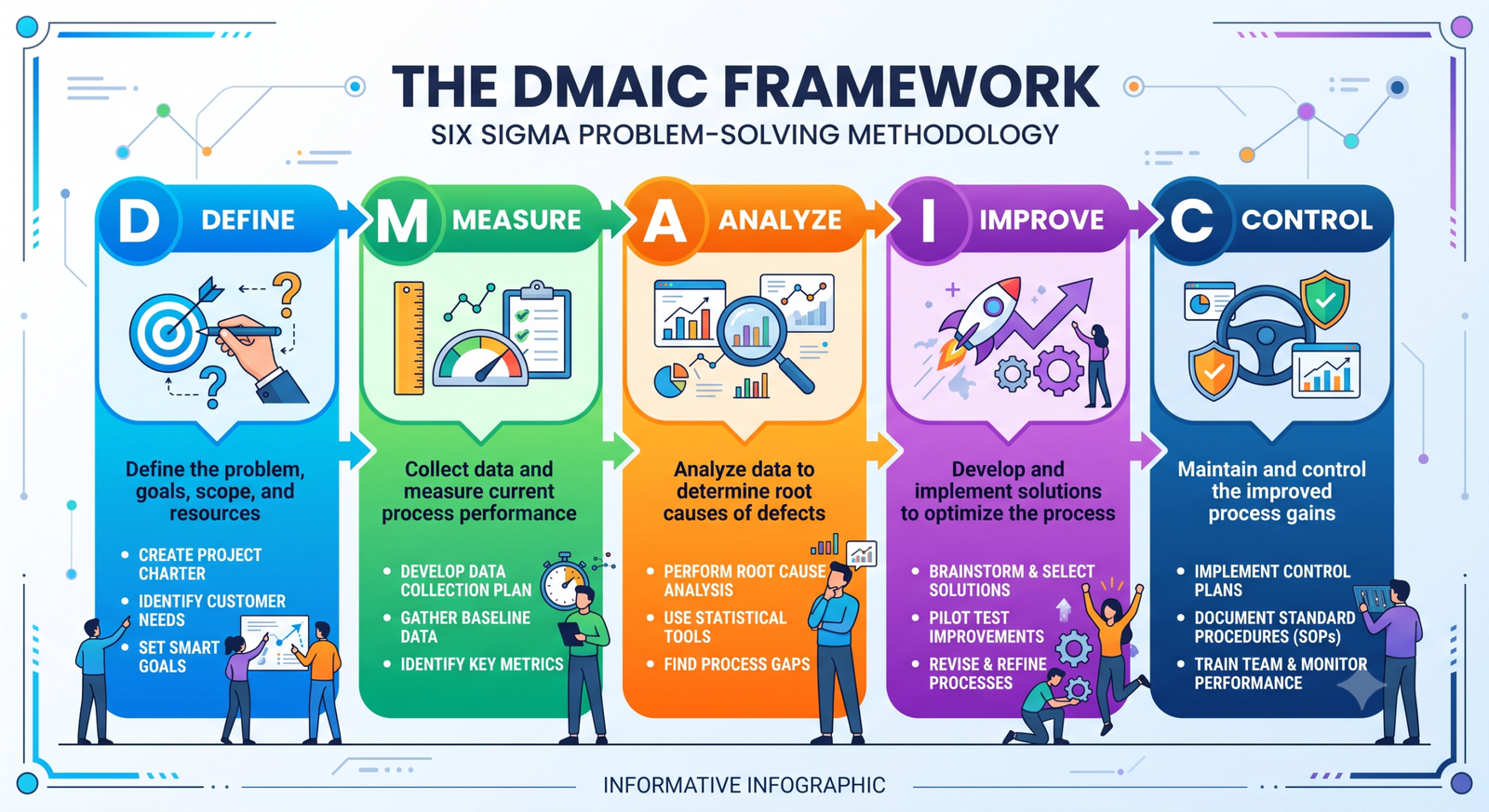
The Six Sigma standard. This is not for reactive firefighting. It is for long-term operational stability.
Move your culture from “guessing” to “measuring.”
- Define: The problem and goals.
- Measure: Current performance through data.
- Analyze: Pinpoint the issues.
- Improve: Test and implement fixes.
- Control: Sustain the new improvements.
Best for: Process inefficiencies and continuous improvement.
The Ultimate Multiplier
Knowing these seven tools is great. Knowing when to apply them is elite wisdom.
These models keep you objective under extreme pressure. But we are entering a new era. Human judgment is now amplified by technology.
Artificial Intelligence is the “8th model.” It is the ultimate multiplier. AI processes OODA loops faster and calculates Decision Trees with unparalleled precision.
The next time a crisis hits… which hat will you put on first?
- Beyond “How Are You?”: Smarter Ways to Support a Burnt-Out Coworker
- Beyond Hard Work: The Subtle Art of Signaling Your Next Promotion
- Beyond “Good Job”: 5 Surprising Ways Your Words Transform Work Culture
- Beyond “Deep Breaths”: 12 Science-Backed Micro-Habits to Reset Your Nervous System in 60 Seconds
- Are You Burned Out or Just Tired? The Subtle Red Flags You’re Likely Ignoring
Author Biography
Dr. Arup Giri is an Associate Professor of Zoology, researcher, author, and scientific editor specializing in Environmental Toxicology, Ecotoxicology, Animal Physiology, and Environmental Health. With 100+ research publications, books and book chapters, and extensive experience in postgraduate and doctoral mentoring, he actively contributes to scientific research and education. He also serves in editorial and reviewer roles for international journals.