
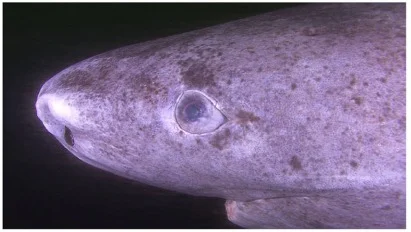
Imagine an animal that was already alive when the Taj Mahal was under construction—and can still see.
In the icy, light-starved depths of the Arctic Ocean swims a creature that defies nearly everything we know about aging, biology, and survival. The Greenland shark (Somniosus microcephalus), the longest-living vertebrate on Earth, can live for 250 to 400 years. For decades, scientists assumed that such an ancient animal—moving slowly through near-total darkness, often with parasites clinging to its eyes—must surely be half-blind, if not completely so.
They were wrong.
A groundbreaking study published in Nature Communications has now revealed a stunning truth: the Greenland shark keeps its vision intact for centuries. Not only does it see—it sees remarkably well for its environment. This discovery is more than a curiosity of marine biology; it may hold clues to how neurons, eyes, and even human vision could be preserved far longer than we ever thought possible.
A Shark That Shouldn’t Be Able to See—But Does
The Greenland shark lives where sunlight barely penetrates. At depths approaching 3,000 meters, temperatures hover around –1°C, and food is scarce. To make matters worse, many Greenland sharks host a parasitic copepod (Ommatokoita elongata) that attaches itself to the cornea, giving the shark an eerie, cloudy-eyed appearance.
For years, these factors fueled a powerful assumption: why invest in vision when smell and electroreception might be enough?
But behavior told a different story. Greenland sharks hunt moving prey, scavenge whale carcasses, and navigate complex environments. Their brains even possess a well-developed optic tectum, the region responsible for processing visual information. Something didn’t add up.
So scientists decided to look—not just at the eyes, but inside the retina, the genome, and the molecular machinery of vision itself.
A Retina Built for Eternal Night
The first surprise came from microscopic examination of the retina. Unlike the human eye, which relies on both rods and cones, the Greenland shark has a pure rod retina. Every photoreceptor is optimized for darkness.
These rods are densely packed, elongated, and arranged to maximize photon capture. Remarkably, even in sharks estimated to be over a century old, researchers found no signs of retinal degeneration. All retinal layers remained intact, with no evidence of cell death.
The Genetic Blueprint of Night Vision
Vision depends on a precise biochemical cascade called phototransduction. Genomic analysis revealed that all essential rod phototransduction genes are intact and actively expressed. In contrast, most cone vision genes have been lost or rendered inactive. This is not degeneration, but evolutionary specialization.
A Blue-Shifted Superpower
The Greenland shark’s visual pigment, rhodopsin, is tuned to blue light, with peak sensitivity around 458 nm—perfect for Arctic deep-sea conditions. This allows the shark to extract maximal visual information from the faintest available light.
Seeing Through Parasites
Despite the presence of eye parasites, corneal transmission studies showed that up to 100% of blue light can still reach the retina. The parasites may look dramatic, but they do not blind the shark.
The Secret Ingredient: DNA Repair
Perhaps the most remarkable discovery was the robust expression of DNA repair genes in the retina, especially the ERCC1–XPF complex. These genes are known to protect against retinal aging. Their strong activity may explain how Greenland sharks maintain visual function for centuries.
Lipids That Keep Vision Flexible
The retina is also rich in DHA and very-long-chain polyunsaturated fatty acids. These molecules maintain membrane flexibility in freezing temperatures, ensuring efficient photo transduction.
Why This Discovery Matters
The Greenland shark proves that vision loss is not an inevitable consequence of aging. Its biology offers insights into neuronal longevity, retinal health, and potential pathways for treating age-related vision loss in humans.
The Takeaway
The Greenland shark has survived for centuries in darkness, cold, and pressure—without losing its sight. Its eyes are not relics of the past, but masterpieces of evolutionary engineering.
The oldest animal on Earth does not just survive—it sees.
Source: Nielsen, M. K., Østergaard, S., Hansen, T. K., et al. (2025). Vision without senescence in the Greenland shark. Nature Communications, 16, Article 7429.
https://www.nature.com/articles/s41467-025-67429-6